ch
ch English
Silicon carbide and gallium nitride have matured
碳化硅(SiC)
氮化镓(GaN)
In addition to SiC and GaN, third-generation semiconductors also include numerous other materials, including group III nitrides (AlN, InGaN, InAlN, AlGaN, AlInGaN, etc.), oxide semiconductors (including ZnO, CaTiO3, IGZO, β - Ga2O3, TiO2), and diamond semiconductors. Silicon carbide based gallium nitride technology began over 20 years ago and has now become a strong competitor to LDMOS and GaAs in RF power applications. Starting with silicon carbide and gallium nitride, followed closely by silicon-based gallium nitride. In addition to its deep penetration in the military radar field, silicon-based gallium nitride is also the preferred 5G massive MIMO infrastructure for telecommunications original equipment manufacturers (OEMs) such as Huawei, Nokia, and Samsung.
In terms of growth rate, the third generation semiconductor has a higher growth rate and volume in power devices than microwave and RF. The microwave field has reached its peak in 2020, but due to the slowdown in 5G construction, there may be a slight decline this year. Therefore, it is speculated that the true application areas of third-generation semiconductors are still in power devices or power electronic devices, with market penetration mainly including new energy vehicles and photovoltaic inverters.
The third-generation semiconductor is still an emerging technology, and the global market is in its early stages. The third-generation semiconductor industry chain mainly includes substrate, epitaxial materials, device design, manufacturing, modules, and applications. In terms of epitaxial and device design, due to the relatively simple technology and low threshold, the gap between domestic and foreign markets is currently small; However, device manufacturing is another aspect with a significant gap. Due to its early development, foreign countries have accumulated a large number of industries in the manufacturing process, and their products have high yield and reliability.
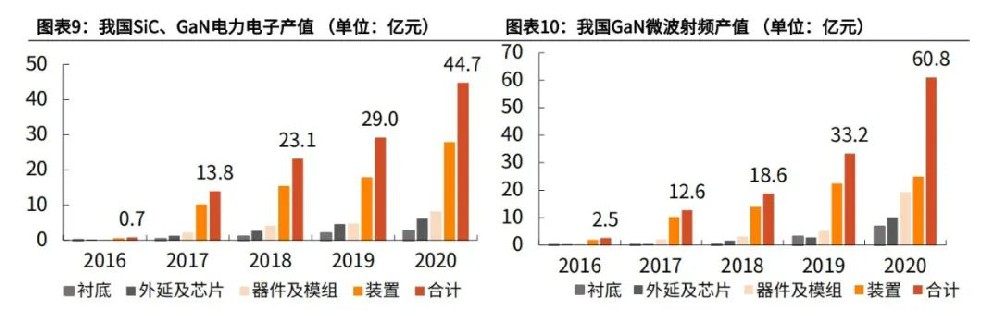
The third-generation semiconductor devices in China have rapidly entered the application fields of new energy vehicles, photovoltaic inverters, 5G base stations, PD fast charging, etc. Silicon carbide is mainly used in new energy vehicles and industrial control, while gallium nitride devices are mainly used in 5G base stations and other fields. In 2020, the total output value of power electronics and RF electronics in China's third-generation semiconductor industry exceeded 10 billion yuan, a year-on-year increase of 69.5%. Among them, the output value of SiC and GaN power electronics reached 4.47 billion yuan, a year-on-year increase of 54%; The output value of GaN microwave RF reached 6.08 billion yuan, a year-on-year increase of 80.3%.
Driven by China's policy efforts, mainstream enterprises in the domestic third-generation semiconductor materials industry are actively expanding their market capacity and continuously improving the level of industrial chain cooperation. China Electronics Technology Group Corporation (CETC) 55th Institute is one of the few domestic enterprises that has achieved a full industry chain in the fields of 4-6 inch silicon carbide epitaxial growth, chip design and manufacturing, and module packaging. And Taike Tianrun has already mass-produced SiC SBD, with products covering 600V/5A~50A, 1200V/5A~50A, and 1700V/10A series. Shenzhen Basic Semiconductor has 3D SiC technology and has launched 1200V SiC MOSFET products. Hanxin has created an integrated silicon carbide JMOSFET structure technology and launched the world's only mass-produced SiC JMOS product, achieving on-chip integration of silicon carbide DMOSFET and JBS (Schottky diode). Additionally, it is worth noting that in recent years, the application of SiC chips as substrate materials has gradually matured, with a significant decrease in cost, laying the foundation for large-scale industrial applications.